Getting to Know Zoom and You
This was the first week in the University of Chicago Harris Data and Policy Summer Scholars. When I first heard about this program, I felt it was the perfect fit for me, lying at the intersection of my interest in data and political sciences. It would be in Chicago for 4 weeks in the summer where I’d work with professors and see if I wanted to further my education in this intersection.
Then in March, COVID hit and the program had to adapt. It was announced that it would move online with the option to defer my admittance to next year. I was a little apprehensive with continuing online, as online classes don’t typically fit my learning style but I decided it would be worth a shot, as the program was extended to 7 weeks which would allow me to particate while working full time.
More Accounts Than You Can Shake A Stick At
Having spent a large part of my first year at PVCSD working to eliminate a system of duplicate email accounts for all users, (Teachers had both gmail and outlook accounts and used both regularly) I was suprised to see that UChicago was also exerincing this. I tweeted in frustration with the number of accounts I had to create.
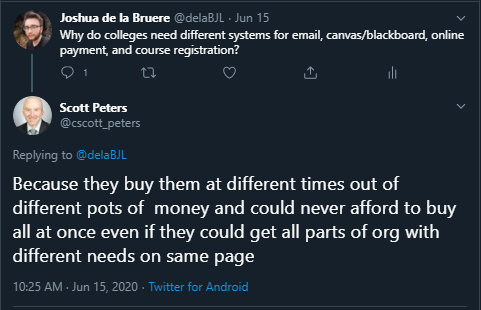
Twitter Exchange About Number of Accounts
There were so many accounts and programs to get set up that the first week was primarily dedicated to making sure that this was happening. There were virtual tech help sessions for setting up the mulititudes of programs required for this course. Some of the accounts I had to set up were
- UChicago email in Office 365
- UChicago email in Google Suite
- Box for sharing recordings
- Canvas for course materials and announcements
- Piazza for discussions
- Slack for discussions and announcments
- Zoom Using the Office 365 email (can’t use my personal one)
To me, I see a fair bit redundancy in these programs. The double email situation is odd to me, as we really only have the Google Suite Account for Google Drive and basically the Google Email is free with that. However, on the other side the Office 365 account is similar in function to Google Drive.
I don’t fully understand the decision to live in two systems for email and cloud collaberative documents. I’m personally more familiar with Google Drive having used it since I was in high school and at each of my previous schools and would prefer to live in that world. However, I know Office is the heart and soul of the buisness world.
Box seems pretty useful for sharing recordings with students as the program is designed to be mostly async. I would note that if we were using Google Meet that a copy of the recording is automatically sent to all involved parties, which would decrease the waiting time.
Canvas and I have a love hate relationship. I’ve used Canvas and Blackboard before and I hate them both. Canvas is the worst based learning management system I’ve used, except all those other forms that have been tried from time to time. I’m less familiar with the capabilites of Google Classroom, but from what I’ve seen of the use of Canvas so far a Google Classroom would probably work just as well.
Piazza is interesting and looks a little dated. Like mid 2000s to 2014ish discussion boards. It allows for annon posting, to ask questions that a student might not feel comfortable asking in person which is a nice tool to have. It does feel dated, but I’m not sure if a great alternative exsists.
We’re also using slack, which is super handy. With the threads in Slack I’m not 100% sure why we’re using this and Piazza other than maybe annon posting. Slack to me makes sense the most out of all of these programs, though it’s a little annoying that I had to create a new Slack account to participate.
Zoom is probably the best online confrencing system I’ve used, and with PVCSD I’ve used a lot when contacting vendors. Google Hangouts seems to have lower quality video and is a little weirder when it comes to sharing content on the screen, but is probably my second favorite video confrencing app, though many features in Zoom require a plug in in Google Meets.
I think at this point it should be pretty clear that I feel that many of these programs could be accomplished with a single login to a Google Suite Account. This is of course from a student perspective, I could be missing a critical reason for using Cavas on the backend for instructors for example. It just feels like a lot of log-ins for a seven week course.
Icebreakers Over Zoom Are Still Awkward
Icebreakers are awkward. Zoom conversations are awkward. Icebreakers + Zoom = 2Awkward
I really appreciate how the staff is trying to ensure that we do form as a cohort as that was one of the major draws to the program. However, it still feels kind of forced especially over Zoom, though hopefully that will fade with a little more time. I wonder what other students in extremely different timezones feel about this aspect of the program right now.
For our first cohort meeting we were divided into smaller groups (around 15 people I think) and told we had something in common and we had to figure that out. This was based of the pre program survey, which I had filled out about a week ago and could not remember what the questions were or what I had answered for them. I’m awful at doing bios so I usually rush through them. We went around introducing ourselves and listing some of our hobbies but there didn’t seem to be a huge theme. A few of us liked to cook, a few of use played instuments, and then there were a few other groupings. Eventually we learned that we were the cohort of misfits who didn’t fall neatly into any of the categories: the island of misfit toys. We ran into the issue of figuring out the order of introductions. A few people suggested going clockwise around the video ribbon in Zoom which seemed like a good system until we realized that you are always the first one in your video ribbon, the order of video can change, and finally eveyone likely has a different order.
The next cohort meeting we played two truths and a lie. This is a really great game to play with friends and aquantencese to get to know them better. I don’t know if we were just on top of our game or were really bad liars, but we all seemed able to get the lie pretty quickly. It sort of made me wonder about the strategy of playing this game with strangers who have different cultural backgrounds. Something that seems odd to me might be totally normal for others. One of my go to false flags for this game is about the age I started driving where for most midwesterners it’s far later than they expect, but for many people in this program that seemed totally normal.
Finally for the last cohort meeting this week we played fill in the blank bingo. This was pretty fun, and had us taking turns asking others questions while trying to get a bingo based on the cards. Question bingo is the best icebraker that I’ve done in a while. 10/10 for icebreakers over Zoom.
Zoom Classes
This week there werw a few Zoom based classes. One was an English workshop that I didn’t have to attend as it was aimed at students for whom English is not their primarly language. There were two tech bar sessions to make sure students were signed up for the programs correctly and that they had installed the latest version of R and R studio. I didn’t attend these as I felt confident in my ability to get these set up or in the case of R, I already had these on my computer.
And finally there was our first career workshop day which covered a lot of the typical resume crafting advice. As this program runs the gambit of those in their undergrad to those in graduate programs this makes sense to have, but for the most part didn’t feel applicable to me. I’ve heard about action words, crafting a narritive, and networking many many times and I think most students attending this program (which required a resume/statement of purpose) probably are familiar with these concepts.
There was an interesting exchange where the presenter included an example of restructuring an essay to grab the readers attention using an essay from a former student where that student (presumably white based on the context) was preforming an act of kindness for someone and while that happened they heard another white person using a racially charged slur in regards to the person they were helping. I think the point of this essay that this exceprt came from was about how this was this privlaged students first encounter with the reality of racisim and its prevalence. However, a stundent in the session mentioned that it made them feel uncomfortable because they have actually been called slurs in their day to day life. It sort of felt like the author was using the experience of oppressed minorites to further themselves. While this excerpt did show how crafting a narative can make you want to read further, it did feel a bit strange once I realized that the author was likely white.
Virtual Living Rooms
One of the other Zoom oppertunities that was offered was a virtual living room. I sort of expected this to be more of a hanging out session, but the one that I attended had a lot of really good discussion on race, police, and the protests. The discussion felt very relatvent and other students talked about how they felt about the aformentioned essay example and made a lot of good points. I think the virtual living rooms are going to be some of the best contnent from this program
Wrapping Up
And that’s about it for week one. Not a lot of “contnt” covered in regards to learning about R and public policy yet, but this week is critical for making sure students are good to go. Claus Wilke had a fantastic thread about this back in early march before everything shut down. Getting software installed is difficult when you can be present to provide support and becomes even more so when you can’t easily get live support. This is key for equitable access.
I’m excited for what the next week brings!

Joshua de la Bruere
Data Specialist
I’m currently a data specialist for Pleasant Valley Community School District and grad student at Western Illinois University. My research interests include machine learning, electoral systems, and statistical software.